How to Calculate Diesel Generator Fuel Consumption and Running Cost
The four-number method that turns a nameplate into a monthly diesel bill — with worked examples from 120 kW to 400 kW
To calculate diesel generator fuel consumption, multiply the engine's full-load fuel burn (litres per hour) by a load factor, then multiply by running hours and your local diesel price. A diesel generator burns roughly 210–215 g of fuel per kWh at 100% load, and the practical load factor at 50–75% load is about 0.38 to 0.65 of full-load consumption. One number, three multiplications — that is the entire calculation.
Every diesel generator quotation ends with the same question — “but what will it cost me to run?” The honest answer is that the machine's price is a one-off number, while the fuel bill arrives every single month for the next fifteen years. Getting the calculation right is worth more than negotiating a discount.
Three inputs drive the entire model: the engine's full-load fuel consumption, the load factor at which you actually run, and hours of operation. Everything else is a multiplier.
For a quick order-of-magnitude check before you have the datasheet in hand, use the specific-consumption shortcut:
That density figure is not a guess. EN 590, the European diesel specification, defines density at 15 °C as 0.820–0.845 kg/L, with 0.830–0.835 kg/L typical. Use 0.835 for warm climates and 0.845 for cold-start winter blends.
Most fuel estimates go wrong before the arithmetic starts, because the wrong number gets picked off the spec sheet. Three figures matter:
This is the engine's true economy figure and is independent of size. Modern turbocharged, aftercooled industrial diesels typically sit at 205–220 g/kWh at full load. Older naturally aspirated units can reach 240–260 g/kWh. When comparing two suppliers, this single number settles the argument.
Already converted to volume, already accounting for the alternator load. Take it straight from the generator set datasheet, not the engine datasheet. The difference between the two is 10–18% and it is all alternator and fan losses.
ISO 8528-1:2018 defines these four ratings, and they are not interchangeable. An emergency standby (ESP) set is limited to 200 hours per year; a prime power (PRP) set runs unlimited hours with a 24-hour average load factor capped at 70% and a 10% overload allowance for one hour in twelve. Sizing fuel off the standby rating understates consumption by roughly a tenth — and if you run a standby-rated set as prime power, you are outside its design envelope.
| Rating class | Max hours / year | 24 h average load | Overload | Typical use |
|---|---|---|---|---|
| COP — Continuous | Unlimited | 70–100%, constant | None | Base-load plants, island grids |
| PRP — Prime | Unlimited | ≤ 70% | 10% for 1 h / 12 h | Off-grid sites, mining camps, unreliable grids |
| LTP — Limited-Time | ≤ 500 | Up to 100% | None | Peak shaving, load curtailment |
| ESP — Standby | ≤ 200 | ≤ 70% | None | Hospitals, data centres, buildings |
Source: ISO 8528-1:2018, Reciprocating internal combustion engine driven alternating current generating sets — Part 1: Application, ratings and performance. The 2018 revision also introduced DCP (data centre power) and MAX ratings.
This is the part almost every online calculator gets wrong. Fuel consumption is not proportional to load, because a large share of the burn goes to overcoming internal friction, driving the water pump, the oil pump and the cooling fan — costs that exist whether or not you are drawing current.
A practical engineering approximation widely used in the industry takes the form:
Working it through for three real generator sets from our current production range:
Table 1 — Hourly fuel consumption and specific consumption by load
| Generator set | Full load L/h (PRP) |
25% load L/h |
50% load L/h |
75% load L/h |
100% load L/h |
|---|---|---|---|---|---|
| 120 kW / 150 kVA Perkins 1106A-70TAG2 |
33.4 | 6.5 | 12.9 | 21.8 | 33.4 |
| 200 kW / 250 kVA Cummins 6CTAA8.3-G9 |
57.0 | 11.0 | 21.9 | 37.3 | 57.0 |
| 400 kW / 500 kVA Cummins QSZ13-G3 |
101.0 | 19.6 | 38.9 | 66.0 | 101.0 |
Full-load values taken directly from ZTA Power published datasheets; part-load values derived using the load-factor curve above and cross-checked against engine-specific fuel maps.
Table 2 — Efficiency per kWh: the sweet spot is not at full load
| Generator set | @ 25% load | @ 50% load | @ 75% load | @ 100% load |
|---|---|---|---|---|
| 120 kW / 150 kVA | 180 g/kWh | 179 g/kWh | 203 g/kWh | 232 g/kWh |
| 200 kW / 250 kVA | 184 g/kWh | 183 g/kWh | 207 g/kWh | 238 g/kWh |
| 400 kW / 500 kVA | 163 g/kWh | 162 g/kWh | 184 g/kWh | 211 g/kWh |
Specific consumption = hourly litres × 835 g/L ÷ kW delivered. Conversion assumes 0.835 kg/L diesel density per EN 590.
Fuel is the headline, but the full running cost has four lines. Clients who budget only for fuel are usually surprised in year two, when the 500-hour service intervals start arriving in clusters across a multi-unit fleet.
Fuel (70–85%). Calculated with the method above. The only line that scales directly with hours — and the only one you can genuinely reduce through right-sizing and load management.
Lubricating oil (3–6%). Change interval is set by the engine OEM — commonly 500 hours on Cummins 6CTA and Perkins 1100-series units. A 6-cylinder industrial engine holds roughly 20–24 litres of sump oil; add 10–15% for filter replacement and top-up between changes.
Filters and consumables (3–6%). Fuel filter, air filter, lube filter, coolant conditioner and belt inspection, all on the same 500-hour cycle. Air filters are the item most often underestimated on dusty sites — mining and construction duty can halve the nominal interval.
Labour and downtime (5–10%). Usually a fixed call-out plus hourly rate, so scheduled maintenance is far cheaper than reactive repair. A generator set serviced on schedule reaches 20,000+ hours before major overhaul; one run to failure typically does not.
Table 3 — Worked annual fuel cost, 400 kW prime power at three load points
| Operating point | L/h | Litres / 1,000 h | Cost @ USD 0.90/L | vs 75% load |
|---|---|---|---|---|
| 1,000 h @ 50% load (200 kW) | 38.9 | 38,885 | USD 34,997 | −41% |
| 1,000 h @ 75% load (300 kW) | 66.0 | 66,029 | USD 59,426 | baseline |
| 1,000 h @ 100% load (400 kW) | 101.0 | 101,000 | USD 90,900 | +53% |
Diesel price shown as a neutral reference; substitute your landed fuel price. Values rounded.
Read that table carefully, because it hides a commercial decision. Running at 50% load costs 41% less in absolute terms — but delivers half the energy. Per kWh, the 50–75% band is where the money is efficient; absolute spend is a function of how much power you actually need to produce.
The formula is simple. Reality is not. These five variables routinely move a fuel estimate by 10–40%, and every one of them should be discussed before a generator set is specified.
| Input | Effect on consumption | How to correct it |
|---|---|---|
| Load profile shape | A steady 70% load is more efficient than alternating 20% and 100%. Every swing passes through the low-efficiency region twice. | Ask for a 24-hour load log. If you have none, install a data logger for two weeks before ordering. |
| Altitude | Above 1,000 m, output derates roughly 3% per 500 m. The load percentage rises for the same kW demand, pushing the engine toward full load. | Apply the engine OEM derating chart, then re-plot the load point on the curve. |
| Ambient temperature | Above 40 °C, about 3% output derating per 5 °C, plus higher cooling-fan power draw. | Specify the ambient design condition at site, not at the port of departure. |
| Fuel quality | High-sulphur or contaminated diesel raises consumption, fouls injectors and shortens filter life. Water ingress is the leading cause of fuel-system faults. | Specify EN 590 or ASTM D975 grade and fit a fuel-water separator — a standard option on every ZTA set. |
| Long idle periods | Running at under 30% load for extended periods causes wet stacking: unburned fuel and carbon accumulate in the exhaust and dilute the oil. | Apply a minimum 40–50% load rule, or add a load bank. Underloading is more damaging than mild overloading. |
Calculations get you to the specification. Measurement tells you whether the machine on your foundation is behaving. Three methods, in ascending order of rigour:
Fill the day tank to a marked level, record the hour meter, run for a defined period, refill to the identical mark from a graduated container. Divide litres by hours. Do this over at least three days to smooth out load variation.
Modern controllers log kW-hours and fuel used directly. The Deepsea DSE6120 control panel fitted as standard on ZTA sets includes a configurable 100-event log, accumulated kWh/kVAh/kVArh monitoring and a fuel usage monitor — enough to build a monthly consumption report without buying instrumentation. Export the log every quarter and compare g/kWh against the datasheet. A drift of more than 8% points toward injector wear or a fouled air filter.
Weigh the fuel supply on a scale, run at fixed load steps for a fixed time, weigh again. This is how engine OEMs produce their published curves, and how our own factory acceptance tests are run on every unit before packing — details in the case study below.
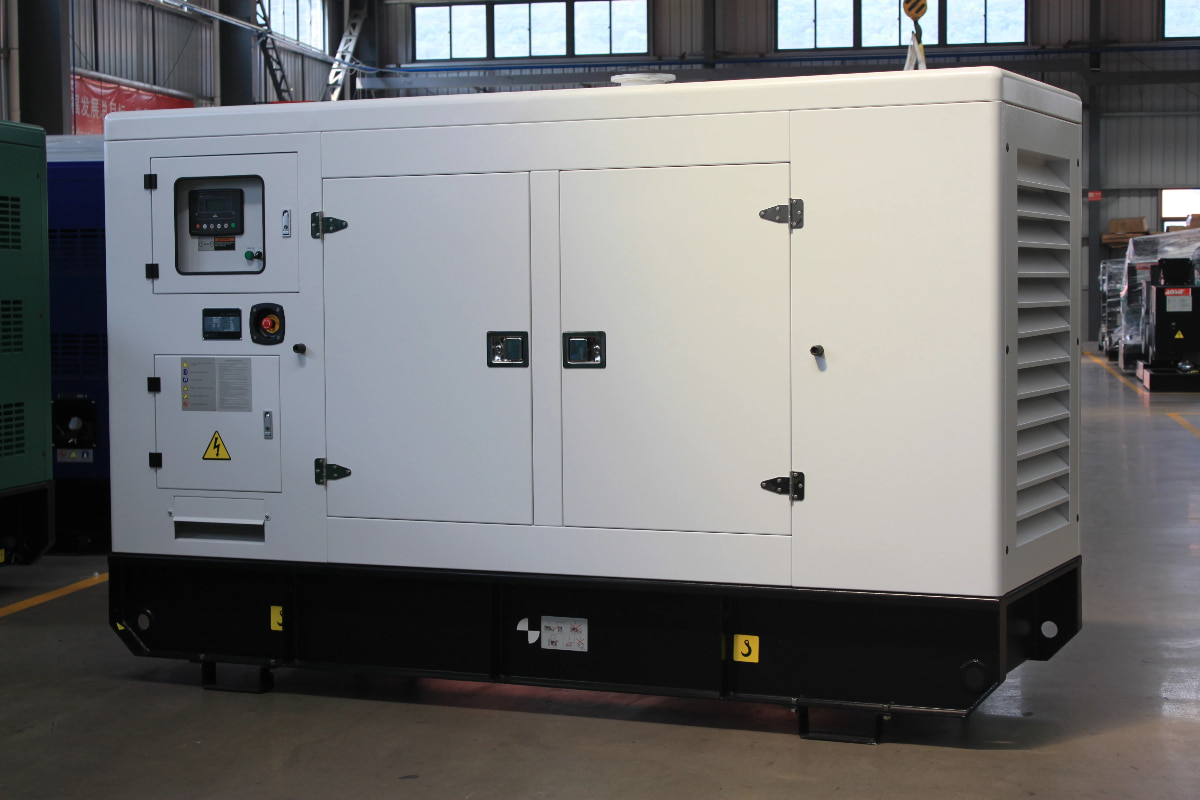
A 120 kW / 150 kVA generator set built around the Perkins 1106A-70TAG2 and a Leroy-Somer alternator is tested on our Xiamen floor before shipment, not just assembled and crated. The load test runs the unit through 25%, 50%, 75% and 100% of prime rating in steps, holding each point until coolant and oil temperature stabilise, then logging fuel draw against a calibrated supply.
See the full specification for the Perkins 120 kW / 150 kVA genset →
Send us your 24-hour load log — or just the peak kW, the average kW and your diesel price — and our engineers will return a one-page calculation with hourly consumption, monthly fuel cost and the recommended rating class. No obligation, no sales script.
Q.How much fuel does a diesel generator use per hour?
A diesel generator uses roughly 0.21 litres per kWh at full load, so a 100 kW set burns about 21 L/h, a 200 kW set about 42–57 L/h, and a 400 kW set about 100 L/h at prime rating. At half load the figure falls to about 38% of full-load consumption, not 50%, because fixed engine losses do not disappear.
Q.What is the formula for diesel generator running cost?
Running cost per hour = hourly fuel consumption (L/h) × diesel price (USD/L). Add oil, filters and service labour for total cost of ownership. For annual budgeting: hourly cost × running hours per year, then add scheduled maintenance at every 500 operating hours.
Q.Is it cheaper to run a generator at 50% or 100% load?
Per kWh delivered, 50–75% is the most economical band: a 400 kW set consumes 162 g/kWh at 50% load versus 211 g/kWh at 100%. Absolute fuel spend is still lower at 50% because you are producing less energy. Below 30% load, efficiency and engine health both deteriorate.
Q.How many litres is a tonne of diesel?
At the EN 590 reference density range of 0.820–0.845 kg/L, one tonne of diesel is approximately 1,183 to 1,220 litres, with 1,198 L the usual working figure at 0.835 kg/L. Volume changes with temperature at roughly 0.08% per °C, which matters when fuel is delivered by mass but consumed by volume.
Q.What is your MOQ and lead time?
MOQ is one unit — we do not require container quantities. Standard lead time is 3–4 weeks from order confirmation, with 30% T/T deposit and 70% before shipment as standard terms. Containerised and synchronised multi-unit packages typically need 5–6 weeks depending on configuration.
Q.Can you supply 60 Hz and non-standard voltages?
Yes. Every set can be built for 50 Hz at 1,500 rpm or 60 Hz at 1,800 rpm, with 400/230 V, 415/240 V, 380/220 V, 220/127 V and 480/277 V available. Frequency determines engine speed and alternator winding, so it must be fixed at the order stage — it cannot be changed in the field.
Q.What documentation ships with each generator set?
Operation, maintenance and parts manuals; factory test report with load-bank results; wiring diagram; CE and ISO certification copies; and packing list with engine, alternator and generator set serial numbers recorded per unit. We supply a matched serial-number schedule so your asset register can be completed on arrival.
Q.Why buy from ZTA Power rather than a local dealer?
We are a manufacturer, not a reseller, with 17+ years of production experience and OEM partnerships covering Cummins, Perkins, Stamford and Leroy-Somer. Our production capacity is about 200 units per month, which means a custom configuration does not put you at the back of a queue, and our pricing is factory-direct without a distribution margin layered on top.
Q.What is the warranty and what happens after it expires?
Every ZTA generator set carries a 1-year or 1,000-running-hour warranty, whichever comes first, with free parts replacement during the period. Engine and alternator coverage aligns with the OEM's own global policy. After warranty, technical support remains free for the life of the machine and spare parts are supplied at cost — there is no support cliff at month thirteen.
Q.How do I get spare parts in a remote location?
Because the engine and alternator are Cummins, Perkins, Stamford or Leroy-Somer units, consumables and major components are available through the OEM's own global service network — Cummins alone operates more than 2,000 service locations across 190 countries. We supplement that with direct factory supply of ZTA-specific items such as canopy hardware, control panel components and cabling, shipped from Xiamen.
Q.Can you help commission the set and train our operators?
Yes. We provide remote commissioning support as standard, and on-site commissioning with operator training can be arranged for larger projects or multi-unit installations. We also supply a pre-commissioning checklist covering foundation, ventilation, exhaust back-pressure, fuel supply and earthing, so site preparation can be verified before the unit arrives.
Q.How often does a diesel generator need servicing?
Every 500 operating hours or 12 months, whichever comes first, for oil, oil filter, fuel filter and air filter. Deep-sea or dusty site conditions shorten this to 250 hours. A coolant check and belt inspection belongs in the same visit. Units that sit idle still need an annual service, because condensation and fuel degradation do their own damage.
17+ years building generator sets in Xiamen. Every unit load-tested at 25/50/75/100% before crating; the 33.4 L/h figure in this article is a measured factory value, not a copied datasheet.
Load-factor curves, altitude and temperature derating, ISO 8528-1:2018 rating classes and EN 590 fuel density — the engineering behind the arithmetic, explained line by line.
CE and ISO certified production, roughly 200 units per month, sets delivered to more than 200 countries.
Factory test reports, matched serial-number schedules and full manuals ship with every set. 1-year / 1,000-hour warranty, lifetime free technical support, parts at cost after warranty.
ZTA Power — Xiamen ZTA Power System Co., Ltd. | Diesel generator sets 10 kW–1,200 kW, Cummins and Perkins powered, open, silent, containerised and synchronised configurations. | www.ztapower.com | Port of shipment: Xiamen, China.
References: ISO 8528-1:2018 — Reciprocating internal combustion engine driven AC generating sets, Part 1: Application, ratings and performance. · EN 590 diesel fuel specification, density 0.820–0.845 kg/L at 15 °C. · ZTA Power product datasheets: Perkins 1106A-70TAG2 120 kW/150 kVA, Cummins 6CTAA8.3-G9 200 kW/250 kVA, Cummins QSZ13-G3 400 kW/500 kVA. · Deep Sea Electronics DSE6120 MKIII control module documentation.

 IPv6 network supported
 English
 français
 русский
 español
 português
 العربية
 Türkçe
 ไทย
 Tiếng Việt
 Indonesia
 Filipino