What Is The Structure and Principle of Permanent Magnet Generators?
A permanent magnet synchronous generator consists of two main parts: the stator and the rotor. The stator refers to the stationary part during generator operation, primarily composed of silicon steel sheets, three-phase Y-connected symmetrical armature windings distributed in the stator slots with a 120° electrical angle difference between phases, a housing that secures the iron core, and end covers. The rotor refers to the rotating part during generator operation, typically consisting of a rotor core, permanent magnet steel, retaining rings, and a rotor shaft. Permanent magnet materials, especially cobalt-based permanent magnets, have low tensile strength and are hard and brittle. If the rotor lacks protective measures, when the generator rotor diameter is large or operates at high speed, the centrifugal force on the rotor surface may approach or even exceed the tensile strength of the permanent magnet material, potentially damaging the permanent magnets. Therefore, high-speed permanent magnet synchronous generators often use a retaining ring rotor structure. The so-called retaining ring rotor structure involves tightly fitting a thin-walled cylindrical ring made of high-strength metal material around the outer or inner circumference of the rotor. This retaining ring secures the permanent magnet steel and soft iron pole pieces in their respective positions on the rotor. Thus, the rotor of the permanent magnet synchronous generator resembles a complete solid body, ensuring reliability during high-speed operation.
The structural characteristics of permanent magnet synchronous generators are mainly reflected in the rotor. Generally, according to the relationship between the magnetization direction of the permanent magnets and the direction of rotor rotation, they can be classified into tangential type and radial type, etc.
(1) Tangential Rotor Magnetic Circuit Structure
In the tangential rotor magnetic circuit structure, the magnetization direction of the rotor is nearly perpendicular to the air gap flux axis and farther from the air gap, resulting in relatively large magnetic flux leakage. However, the permanent magnets operate in parallel, with two permanent magnet cross-sections providing magnetic flux per pole to the air gap, which can increase the air gap flux density. This is particularly prominent in cases with a high number of poles. Therefore, the tangential type is suitable for permanent magnet synchronous generators requiring a high number of poles and high air gap flux density. The fixation method for permanent magnets and pole pieces uses a retaining ring structure, as shown in Figure 1(a).
(2) Radial Rotor Magnetic Circuit Structure
The radial rotor magnetic circuit structure is shown in Figure 1(b). The magnetization direction of the permanent magnets is consistent with the air gap flux axis and closer to the air gap. In the magnetic circuit of one pair of poles, two permanent magnets provide magnetomotive force, operating in series. The cross-section of each permanent magnet provides the magnetic flux per pole for the generator, and the magnetomotive force of each permanent magnet provides the magnetomotive force for one pole of the generator.
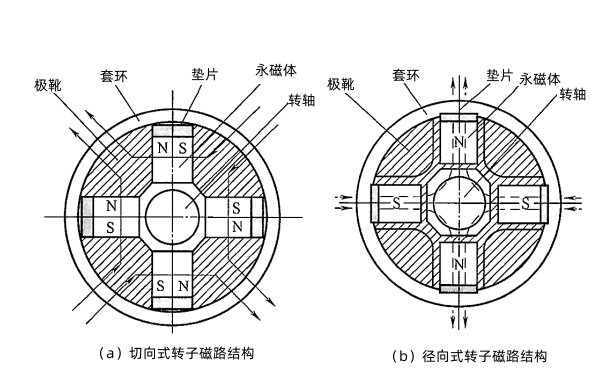
Figure 1: Schematic diagram of permanent magnet generator rotor magnetic circuit structures
Compared with the tangential rotor structure, the radial rotor magnetic circuit structure has a smaller magnetic flux leakage coefficient. In this structure, since the permanent magnets directly face the air gap and have magnetic field orientation, the air gap magnetic flux density Bδ is close to the magnetic flux density Bm at the operating point of the permanent magnets, improving the utilization rate of the permanent magnet material. The permanent magnets in the radial rotor structure can be directly cast or bonded onto the generator shaft, making the structure and process relatively simple. Aluminum alloy casting between the poles ensures the integrity of the rotor structure and provides a damping effect, which can improve the transient performance of the generator and enhance the demagnetization resistance of the permanent magnet material.
(3) Integrated Rotor Embedded Structure
Currently, in traditional generator sets, the engine and generator are relatively independent. The engine crankshaft has two ends, located at the front and rear of the engine; the front end is equipped with a flywheel and an external starter pull cord; the rear end serves as the output drive, typically used for connecting to the generator. In high-speed generator sets, the generator not only produces electrical energy but also, through moment of inertia calculation, ensures its rotor's moment of inertia equals that of the flywheel, thereby using its rotor to replace the prime mover's flywheel, making it an integral part of the prime mover. This achieves a "high-speed generator integrated embedded structure." This significantly reduces the axial dimensions of the unit and reduces its weight, fundamentally achieving the separation of the hot and cold zones of the generator set, facilitating heat dissipation solutions, and improving system reliability.

 IPv6 network supported
 English
 français
 русский
 español
 português
 العربية
 Türkçe
 ไทย
ไทย Tiếng Việt
 Indonesia
  Filipino