How to Integrate a Diesel Generator with Solar and Battery Hybrid Systems
POWER INSIGHTS · HYBRID SYSTEMS · TECHNICAL GUIDE
How to Integrate a Diesel Generator with Solar and Battery Hybrid Systems
The architecture, the four numbers that size it, and the control logic that decides whether a hybrid plant saves 60% of its fuel bill — or quietly destroys the engine.
By ZTA Power Engineering Desk · Xiamen, China Updated November 2026 · 11 min read
A diesel generator integrated with solar and batteries is not a smaller generator with panels bolted on. It is a three-source microgrid in which the genset stops being the primary supply and becomes the plant's last resort — and, counter-intuitively, the component most likely to be damaged if the integration is done badly. The engineering question is therefore never "how much solar can I add", but "what is the genset doing while the sun is out".
|
QUICK ANSWER To integrate a diesel generator with solar and battery storage, size the PV array to supply 50–70% of daily kWh, size the battery for the night load plus one full genset charging cycle, keep the genset above 40% load whenever it runs, and let a single controller dispatch all three sources on one AC bus. The genset is not removed from the plant — it is re-tasked as backup of last resort and charger of first resort. Get those four decisions right and a hybrid plant typically cuts diesel consumption by 55–70%; get the minimum-loading rule wrong and the same plant will glaze its cylinders within two years. |
|
KEY TAKEAWAYS ▪ The genset must run above 40% load, always. Below that threshold, unburnt fuel washes cylinder walls and dilutes lube oil — the classic "wet stacking" failure that no warranty covers. ▪ Battery sizing is driven by night hours, not by generator size. A 24 kW genset paired with a 61 kWh LFP bank covers a 42 kWh night load at 80% depth of discharge. ▪ PV above roughly 70% of daily demand creates surplus it cannot use unless the battery and controller can absorb or curtail it — the most common over-specification error in off-grid tenders. ▪ AC-coupled architecture retrofits an existing genset in most cases; DC-coupled is more efficient for new builds but forces the genset onto the inverter's AC output. ▪ Reverse power protection is mandatory. The moment PV output exceeds site load, power flows back into the genset — 2–5% of rated kW is enough to damage a machine that has no such relay.
|
01 Choose the Coupling Architecture Before Anything Else
There are two ways to connect a solar diesel hybrid system, and the choice constrains everything downstream: equipment list, retrofit feasibility, efficiency, and who owns the voltage reference on the bus.
Table 1 — AC-coupled vs DC-coupled hybrid architecture
|
Criterion |
AC-coupled |
DC-coupled |
|
Power path |
PV → grid-tie inverter → AC bus; genset and battery inverter also on AC bus |
PV → MPPT charge controller → DC bus → hybrid inverter → AC bus |
|
Existing genset |
Kept as-is; add inverter, battery, EMS, reverse-power relay |
Kept, but must accept the inverter as grid-former |
|
Conversion losses |
Two conversions when charging from PV (DC→AC→DC), roughly 6–10% |
One conversion for charging, roughly 3–5% |
|
Best fit |
Retrofit of an installed standby or prime set; staged expansion |
New-build containerised plants; sites with long PV cable runs |
|
Weak point |
Frequency and voltage reference must be arbitrated between three sources |
Single point of failure at the hybrid inverter; battery voltage limits string length |
|
Typical use |
Telecom sites, clinics, small factories adding PV to an existing set |
Remote mining camps, island microgrids, 20–500 kWh/day demand |
Architecture comparison per IEC 62548 (PV array design) and IEC 62109-1/-2 (inverter safety) practice.
For most clients reading this, the answer is AC-coupled: they already own a generator, and the retrofit avoids touching the alternator, cabling or changeover switch. The trade-off is 3–5 percentage points of round-trip efficiency — real, but rarely decisive against the cost of replacing a working genset.
02 Four Numbers That Size the Plant
Hybrid plants are usually mis-sized in the same order: PV too large, battery too small, genset too small, and control setpoints left at factory defaults. Work through these four calculations in sequence and the specification falls out.
Number 1 — PV array, from daily energy not from peak load
|
PV (kWp) = Daily load (kWh) × PV share ÷ (Peak sun hours × 0.75) The 0.75 factor bundles module soiling, temperature derating, wiring and inverter losses. Use site-specific peak sun hours — 4.0–5.0 h for most of Africa and the Middle East, 3.0–4.0 h for island and monsoon climates, 5.5–6.5 h for high-altitude desert. |
Number 2 — Battery, from night hours and depth of discharge
|
Battery (kWh) = Night load (kW) × Night hours ÷ (Depth of discharge × 0.92) 0.92 is inverter round-trip efficiency. LFP is normally cycled to 80% DOD; lead-acid to 50%. Do not size to 100% DOD to save money — cycle life collapses. |
Number 3 — Genset, from the residual energy and the 40% floor
|
Genset (kW) = (Peak load − Battery contribution) × 1.25 The 1.25 covers motor starting and simultaneity. Then check the reverse case: when the genset runs, its load must stay above 40% of rating — if the battery is charging at the same time, that is usually satisfied automatically. |
Number 4 — Renewable fraction, which is what the client actually buys
|
RF (%) = PV energy delivered ÷ Total energy delivered × 100 Measure it from the controller's kWh counters after commissioning, not from the design spreadsheet. A plant specified at 65% RF that measures 48% has a curtailment or setpoint problem, not a sunshine problem. |
Table 2 — Worked example: remote site, 80 kWh/day, 25 kW peak, 3 kW baseload at night
|
Step |
Calculation |
Result |
|
PV array |
80 × 0.63 ÷ (4.5 × 0.75) |
15 kWp |
|
Battery |
3 kW × 14 h ÷ (0.8 × 0.92) |
57 kWh → 12 × 5.12 kWh LFP packs = 61.4 kWh |
|
Genset |
(25 − 8) × 1.25 |
21 kW → 24 kW / 30 kVA prime |
|
Daily PV yield |
15 × 4.5 × 0.75 |
50.6 kWh (63% of load) |
|
Residual for genset |
80 − 50.6 |
29.4 kWh → about 1.2 h at full rating |
|
Fuel, hybrid |
29.4 kWh × 240 g/kWh ÷ 835 g/L |
8.4 L/day |
|
Fuel, diesel-only baseline |
80 kWh × 0.33 L/kWh |
26.4 L/day |
|
Renewable fraction |
50.6 ÷ 80 |
63% |
Load profile assumed constant at night and 25 kW peak during working hours. Fuel values use 240 g/kWh at the genset's operating point and 835 g/L diesel density per EN 590.
A hybrid plant does not save fuel because the sun is free. It saves fuel because the genset stops running at 15% load for eighteen hours a day.
03 Control Strategy: Where the Savings Actually Live
Three dispatch philosophies dominate, and the difference between them is worth more than any hardware upgrade. In simulation studies and in our own commissioning logs, the same hardware set delivers fuel savings that vary by 20 percentage points depending purely on the strategy programmed into the controller.
Table 3 — Dispatch strategies for a genset-plus-storage microgrid
|
Strategy |
How it dispatches |
Fuel outcome |
Best for |
|
Load following |
Genset output tracks the load; battery charges only from surplus PV |
Lowest fuel per kWh, but genset spends time at part load |
Sites where PV is large and genset runs short blocks |
|
Cycle charging |
Whenever the genset runs, it runs at high load and charges the battery to a target SOC |
Fewer running hours, higher load per hour — best overall fuel figure in most off-grid cases |
Weak-grid and island sites with one daily load peak |
|
Predictive / EMS |
Forecast-driven; shifts charge windows, anticipates cloud and load peaks |
Another 3–8% saving over cycle charging |
Plants above roughly 100 kWh/day, or where tariff arbitrage matters |
Strategy taxonomy follows the load-following / cycle-charging convention used in HOMER-style hybrid optimisation; setpoints from ZTA GSB-series commissioning defaults.
Setpoints that matter more than the strategy name
These five values are where commissioning either succeeds or quietly fails. They belong in the technical submittal, not in a factory default buried in a menu:
|
Parameter |
Typical setting |
Why |
|
Genset start SOC |
20–30% |
Low enough to use the battery, high enough to leave black-start reserve |
|
Genset stop SOC |
85–95% |
Leaving headroom protects the battery from PV overcharge the next morning |
|
Minimum run time |
30–45 min |
Short cycling destroys starters, batteries and patience; also prevents wet stacking |
|
Minimum genset loading |
40% of prime rating |
The single most important protection for the engine |
|
PV ramp limit |
10–20% of PV per minute |
Prevents a cloud-edge transient from tripping the genset or the inverter |
04 What the Genset Must Do Differently
Hybridising changes the duty cycle far more than it changes the machine. A genset that ran 8,000 hours a year at steady 70% load now runs 1,200 hours a year in 90-minute blocks, at high load, with frequent starts. Four things need attention.
Minimum loading and wet stacking
Below about 40% of prime rating, combustion temperature drops far enough that fuel no longer burns completely. The residue glazes cylinder walls, contaminates lube oil and blocks the exhaust. In a hybrid plant this happens for a structural reason: the genset is sized for a peak that the battery now covers, so its average load falls. Either keep the genset small enough to stay above 40%, or program a load bank or a forced charging cycle.
Block load acceptance
When the battery reaches its low-SOC threshold and the site load is already high, the genset must pick up load and start charging simultaneously. ISO 8528-5 defines load acceptance classes G1 to G4; a hybrid plant should specify G2 minimum, G3 for sites with large motor loads. Ask for the block-load percentage at the quoting stage — a set that accepts only 25% will trip on the first cloud event.
Reverse power and motoring
If PV output exceeds site load while the genset is running, current flows backwards into the alternator and the machine motors. Fitting a reverse-power relay set at 2–5% of rated kW with a short time delay is cheap insurance; without it, a single high-irradiance midday event can end with a burnt winding.
Controller and communications
The genset controller must expose remote start/stop and, ideally, Modbus or CAN J1939 to the EMS. A Deepsea or ComAp control panel with remote-start input, engine-protection alarms and accumulated kWh counters is the minimum; anything less and the EMS is running blind.
05 Protection, Earthing and the Standards That Apply
Hybrid plants fail audits on documentation more often than on hardware. This is the standards set a consultant will ask for, and the reason each one appears:
Table 4 — Standards referenced in a hybrid plant submittal
|
Standard |
Covers |
What to submit |
|
ISO 8528-1 / -5 |
Genset ratings (COP, PRP, LTP, ESP) and load acceptance classes |
Rating declaration plus block-load test curve |
|
IEC 60034-1 |
Alternator rating, temperature rise, insulation class |
Type test certificate, H-class confirmation |
|
IEC 62109-1 / -2 |
Safety of power converters, including anti-islanding |
Inverter CB certificate |
|
IEC 62619 + UN38.3 |
Battery safety for industrial LFP; transport testing |
Cell and pack test summaries |
|
IEC 61439-1 / -2 |
LV switchgear and controlgear assemblies |
Assembly design verification |
|
IEEE 1547 / UL 1741 SB |
Grid interconnection, islanding detection, grid-forming capability |
Inverter listing, if grid-tied |
|
IEC 60364-5-52 |
Cable sizing and voltage drop on DC and AC circuits |
Cable schedule with derating factors |
Earthing deserves its own line in the design. Most hybrid plants are TT or TN-S with a single neutral-to-earth bond at the transformer or inverter; adding a second bond at the genset creates circulating current through the PE conductor whenever both sources run in parallel. Decide the earthing philosophy once, draw it, and make every supplier build to that drawing.
06 Seven Commissioning Tests That Prove the Integration Works
A hybrid plant can pass every factory test and still fail on site, because the failure modes live in the transitions. These seven tests are what we run before handover, and they double as the acceptance protocol for EPC contracts.
1. Black start from battery. Isolate all sources, start the inverter from the battery alone, energise the priority load. Time it.
2. Step-load the genset at 25/50/75/100%. Hold each step until coolant stabilises; record frequency dip and recovery time against the ISO 8528-5 class claimed.
3. Measure source-transfer time. Hybrid systems are commonly quoted at under 10 ms; verify with a power quality analyser, not with the datasheet.
4. Force reverse power. Reduce site load while PV is at peak and confirm the relay trips or the controller curtails PV before current reverses into the alternator.
5. Verify minimum loading. Run the genset for one hour with the battery absorbing surplus; log load percentage — it must stay above 40%.
6. Inject BMS alarms. Simulate cell over-temperature and over-voltage; confirm the inverter derates and the genset starts as designed.
7. 72-hour endurance with a cloud transient. Run three days; on day two, disconnect the PV array at midday. The plant must ride through without a single load interruption.
07 Field Case: A Containerised 30 kVA Hybrid Station
|
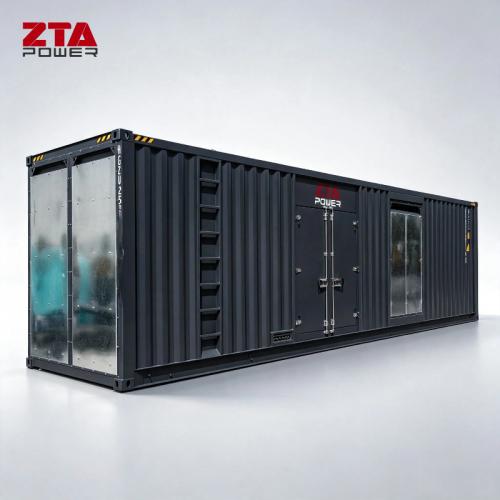
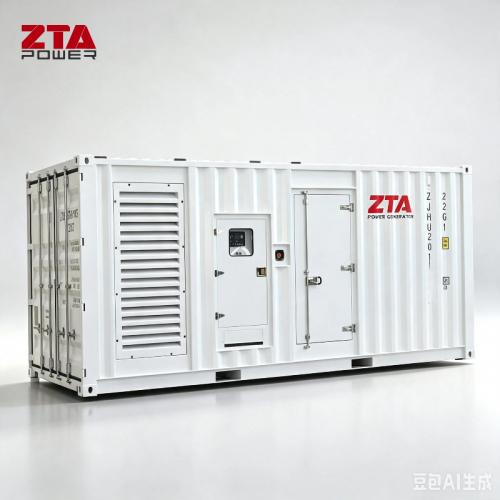
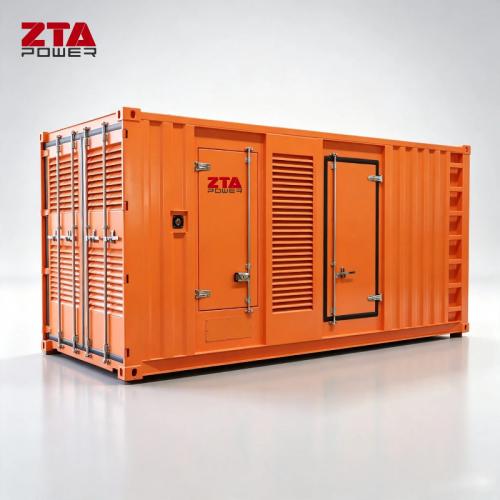
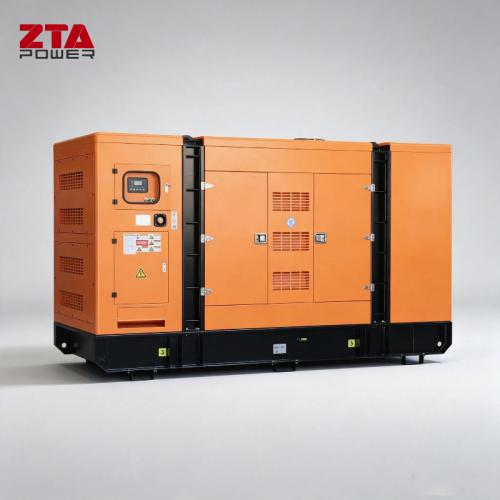
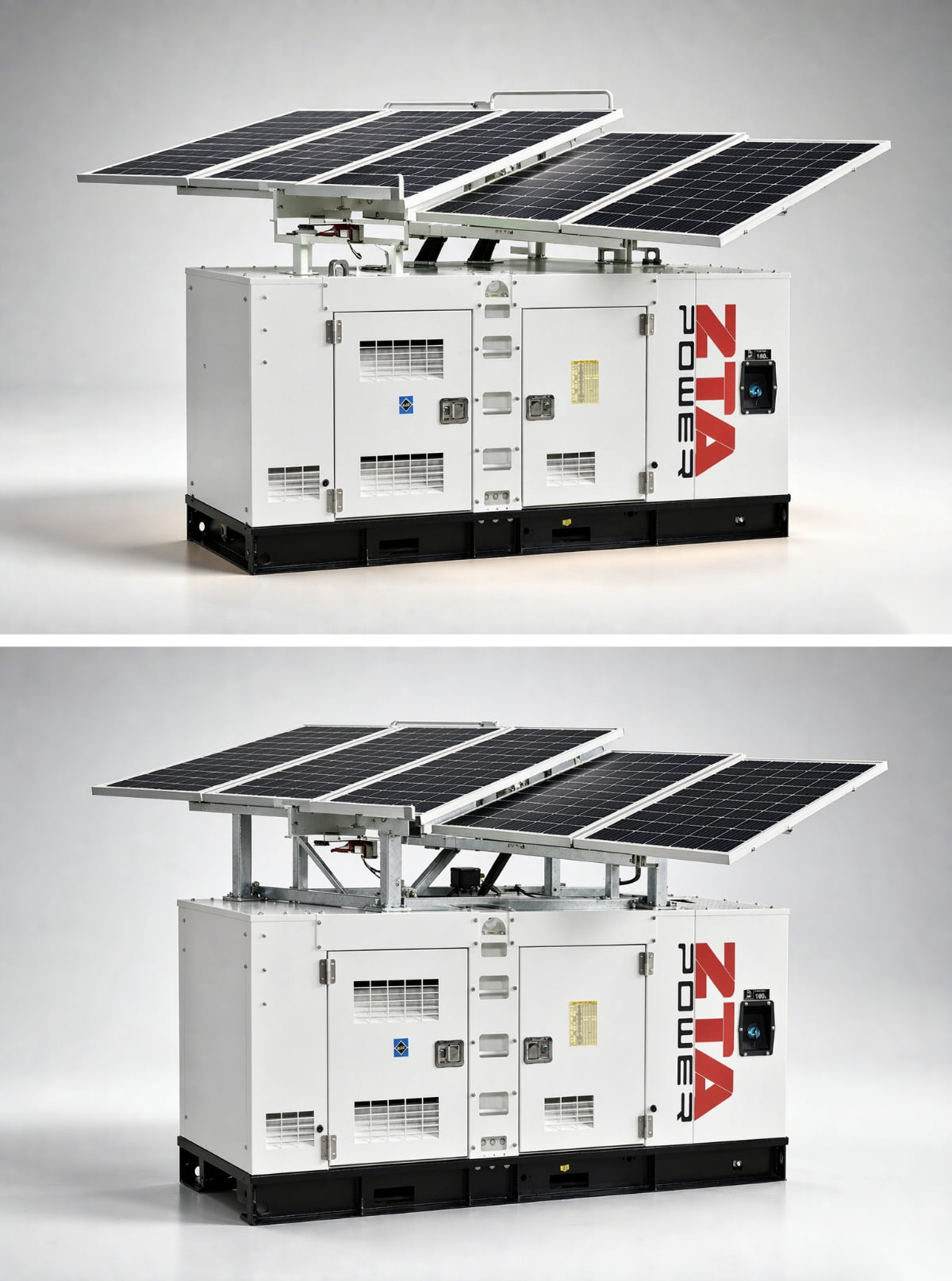
APPLICATION NOTE · ZTA GSB-SERIES HYBRID POWER STATION What the integration looks like as a shipped product The GSB-30 packages the three sources into one acoustic container: a 20 kVA diesel genset (Perkins, Yanmar or Kubota depending on market and emissions tier), a 30 kVA bidirectional hybrid inverter, and a 40–60 kWh LFP battery bank built from 5.12 kWh packs rated 4,000 cycles at 80% depth of discharge. Output is 400/230 V, 50 Hz or 480 V, 60 Hz, with a claimed source-transfer time under 10 ms. ▪ Dispatch: PV first, then battery, genset only when SOC falls below the programmed threshold — adjustable from 20% to 30%. ▪ Charging: when the genset runs, it charges at high load rather than idling, which is what keeps specific consumption near 240 g/kWh instead of 350. ▪ Physical: 100 L day tank, ≤70 dB(A) at 7 m, 3,400 kg, 20GP holds two units and a 40HQ holds six. ▪ Warranty: genset 1 year or 1,000 hours; engine 18 months or 1,500 hours; battery 4,000 cycles or two years. Full specification: GSB-series solar and battery hybrid power station
|
The lesson from building these as a single container rather than three separate purchases is unglamorous: the failure modes are almost all interface failures. Terminal-block temperature between inverter and changeover switch, EMS polling timeouts, battery CAN address conflicts, earthing bonds doubled by two different installers. Packaging the sources together removes the interfaces from the client's scope — which is worth more than the sum of the components.
08 Economics: What the Fuel Saving Is Actually Worth
Take the 80 kWh/day site from Table 2, diesel at USD 1.00/L, and a hybrid add-on capex built from current component prices:
Table 5 — Simple payback, 80 kWh/day off-grid site
|
Line item |
Diesel-only |
Hybrid (63% RF) |
|
Diesel per day |
26.4 L |
8.4 L |
|
Diesel per year |
9,636 L |
3,082 L |
|
Fuel cost per year |
USD 9,636 |
USD 3,082 |
|
Service intervals per year (500 h) |
16 |
3 |
|
Hybrid add-on capex |
— |
≈ USD 22,700 |
|
Simple payback |
— |
3.5 years |
Capex basis: LFP at about USD 150/kWh installed, PV at about USD 500/kWp installed, 30 kVA hybrid inverter and EMS at about USD 3,000, balance of system and installation about USD 3,000. Fuel at USD 1.00/L delivered. Excludes generator replacement deferral and carbon value.
Two honest caveats. First, remote sites pay far more than USD 1.00/L once transport and handling are included — at USD 1.60/L the same payback falls to about 2.2 years. Second, the genset's remaining life extends because running hours drop by 85%; that deferral is real money but rarely appears in a spreadsheet, and it is often the strongest argument for a client who distrusts payback calculations.
09 Frequently Asked Questions
SIZING & CALCULATION
How much solar do I need to cut my diesel consumption in half?
Roughly 50% of your daily kWh divided by (peak sun hours × 0.75). For a site using 80 kWh/day with 4.5 peak sun hours, that is 80 × 0.5 ÷ 3.375 ≈ 12 kWp. In practice you would specify 12–15 kWp, because PV rarely delivers its nameplate yield and the extra capacity covers cloudy days. Cutting diesel by half is achievable without any battery at all if the load runs during daylight; the battery is what moves the saving into the night.
SIZING & CALCULATION
Can I keep my existing diesel generator and add solar and batteries to it?
Yes, in most cases — this is exactly what AC-coupled architecture is for. Three conditions must be met: the existing controller accepts a remote start/stop signal, the genset can be kept above 40% load during its running blocks, and a reverse-power relay is added. If the generator is a small portable set with a manual key start and no AVR, retrofitting is usually not worth it; the control interface costs more than the machine.
SIZING & CALCULATION
What battery size matches a 100 kVA generator?
Size the battery to the energy the genset would otherwise produce, not to the genset rating. A useful rule is 2–4 hours of genset output: for a 100 kVA (80 kW) set, that means 160–320 kWh of usable capacity, or about 200–400 kWh nominal at 80% depth of discharge. Below two hours, the genset will cycle too often; above four hours, you are buying battery capacity that the PV array cannot refill in a day.
SIZING & CALCULATION
Will a hybrid inverter synchronise with a diesel generator?
Only if the inverter is grid-forming and genset-compatible, and only with correct sequencing. Two arrangements work: the genset forms the grid and the inverter follows it (simplest, used in most retrofits), or the inverter forms the grid and the genset synchronises onto it through a motor-operated breaker. A grid-following inverter alone cannot black-start a site — check the datasheet for "grid-forming" or "generator input" before ordering.
ORDERING
What is your MOQ and lead time for a hybrid power station?
MOQ is one unit. Standard configurations ship in 7–15 working days; custom PV capacity, battery expansion or non-standard voltage takes 25–35 days. Multi-unit projects are built in batches so that the first container can sail while the rest are in production.
ORDERING
Can you supply 60 Hz and 480 V for the American or Pacific market?
Yes. Gensets are built at 1,800 rpm for 60 Hz, and the hybrid inverter is available with 480 V output. Frequency and voltage must be fixed at the order stage because they determine engine speed, alternator winding and inverter firmware — none of which can be changed in the field. Standard options are 400/230 V, 415/240 V, 380/220 V, 220/127 V and 480/277 V.
ORDERING
What documentation ships with a hybrid station?
Genset operation and maintenance manual, factory load-bank test report, alternator type test certificate, inverter certificate to IEC 62109, battery UN38.3 test summary and IEC 62619 report, single-line diagram, earthing drawing, cable schedule and an EMS commissioning record with the as-programmed setpoints. We also supply the matched engine, alternator and genset serial-number schedule per unit.
COMPANY
Are you a manufacturer or a trading company?
We are a manufacturer based in Xiamen, China, with 17+ years of generator set production and roughly 200 units per month of capacity. Engines come from Cummins, Perkins, Baudouin, Yanmar and Kubota; alternators from Stamford, Leroy-Somer and Mecc Alte. Hybrid stations are assembled and load-tested on the same floor as our conventional sets, which is why the genset and the inverter are commissioned together rather than shipped separately.
COMPANY
Can you design the system around my load profile, or only sell standard units?
Send a 24-hour load log, or the peak kW plus night baseload, and our engineers will return a sizing sheet with PV kWp, battery kWh, genset rating, expected renewable fraction and monthly fuel estimate. This is done before quotation, at no cost, because a hybrid system specified from a nameplate alone is usually wrong by 30–50% on battery capacity.
SERVICE & SUPPORT
Who commissions the plant and trains our operators?
Remote commissioning is standard: we connect to the EMS, walk your electrician through the seven acceptance tests, and sign off on the setpoints. On-site commissioning with operator training is available for larger projects or first-time hybrid users — typically three days including a full load-bank run and a simulated PV loss event.
SERVICE & SUPPORT
What happens if the battery or inverter fails in a remote location?
The plant is designed to degrade rather than stop: if the inverter trips, the genset still supplies the load through the changeover switch. Battery packs are modular 5.12 kWh units, so a failed pack is replaced individually rather than the whole bank. We hold spare inverter and BMS boards in Xiamen and ship by air within 72 hours; battery packs travel by sea under UN38.3 documentation.
SERVICE & SUPPORT
How often does a hybrid plant need maintenance?
The genset keeps its 500-hour or 12-month service interval, but at 1,200 hours a year that means two services instead of sixteen. Battery and inverter need an annual inspection: terminal torque, cooling fan cleanliness, SOC calibration and firmware check. PV arrays need cleaning every 3–6 months depending on dust — a soiled array is the most common cause of a renewable fraction that quietly drops below its design value.
10 Why You Can Rely on These Numbers
|
EXPERIENCE 17+ years building generator sets in Xiamen. Hybrid stations are assembled and load-tested on the same floor as conventional sets, and the setpoints in Table 3 come from our own commissioning records rather than from a textbook. |
EXPERTISE Sizing formulas, AC- versus DC-coupling trade-offs, ISO 8528-5 load acceptance classes, reverse-power protection and the wet-stacking limit — the engineering behind the arithmetic, stated with the numbers attached. |
AUTHORITY Partnerships with Cummins, Perkins, Baudouin, Yanmar and Kubota; alternators from Stamford, Leroy-Somer and Mecc Alte. CE and ISO 9001 production, PV to IEC 61215/61730, batteries to IEC 62619 and UN38.3. |
TRUST Factory test reports, matched serial-number schedules and full documentation ship with every unit. Genset warranty 1 year / 1,000 hours; battery 4,000 cycles or two years; lifetime technical support with parts at cost after warranty. |
|
Send us your load profile — we will size the plant Give us the daily kWh, the peak kW and the night baseload, and our engineers will return a one-page sizing sheet: PV kWp, battery kWh, genset rating, expected renewable fraction and monthly fuel cost. No obligation, no sales script. Browse hybrid energy generator sets, 10 kVA to 1 MW
|
|||
References: ISO 8528-1:2018 and ISO 8528-5:2022 — reciprocating internal combustion engine driven generating sets, ratings and load acceptance. · IEC 60034-1 — rotating electrical machines, rating and performance. · IEC 62109-1/-2 — safety of power converters for use in photovoltaic power systems. · IEC 62619 — secondary cells and batteries for industrial applications. · UN38.3 — transport testing of lithium batteries. · IEC 61439-1/-2 — low-voltage switchgear and controlgear assemblies. · IEEE 1547 / UL 1741 SB — interconnection and grid-forming inverters. · EN 590 — automotive diesel fuel, density 0.820–0.845 kg/L at 15 °C. · ZTA Power GSB-series hybrid power station datasheet (GSB-10 / GSB-20 / GSB-30).

 IPv6 network supported
 English
 français
 русский
 español
 português
 العربية
 Türkçe
 ไทย
 Tiếng Việt
 Indonesia
 Filipino