ZTA POWER · MOBILE LIGHTING
Mobile LED Light Tower ZLTV5: 8 kW Kubota Diesel Lighting Trailer
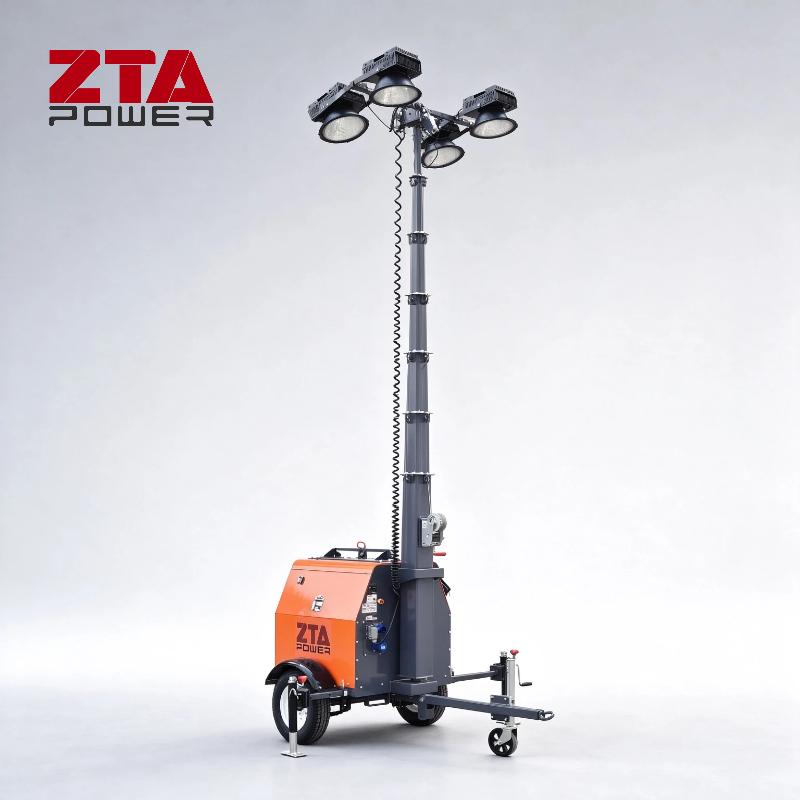
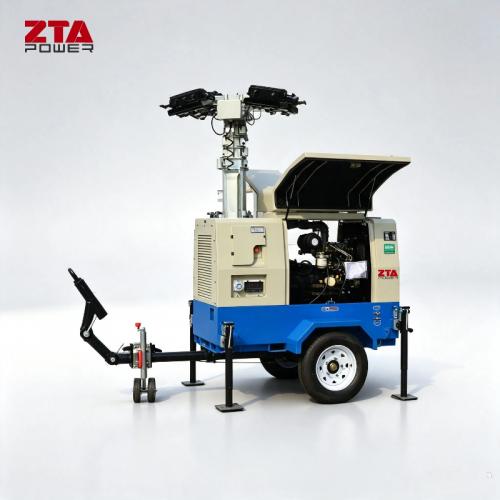
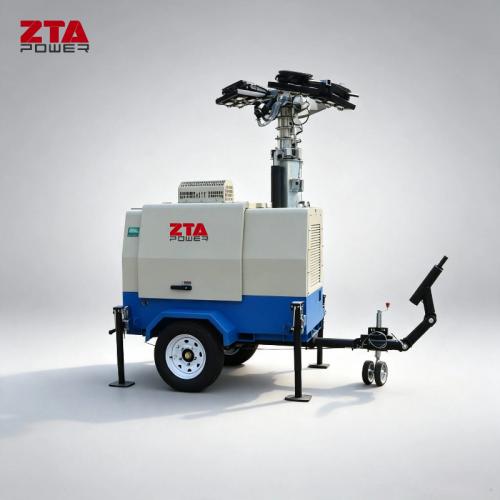
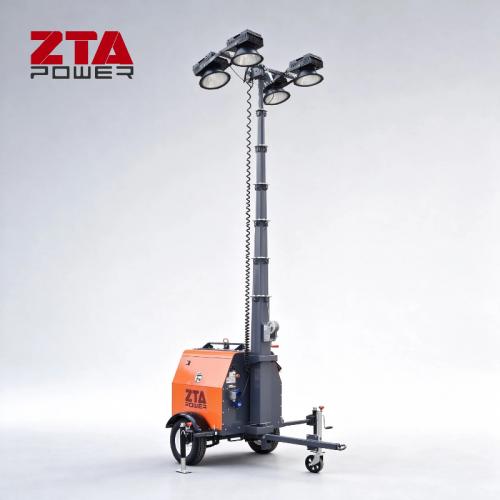
The ZLTV5 is a towable mobile light tower built on an 8 kW / 10 kVA silent diesel generator, driving four 400 W LED floodlights on a 7.5 m five-section telescopic mast. One 120 L tank keeps the lights on for roughly 90 hours, the trailer is rated for 110 km/h wind resistance, and a 40'HQ container holds 20 units. It is engineered for construction sites, mining benches, oil and gas camps, rental fleets and emergency response — anywhere grid power does not reach.
|
At a glance
|
ZLTV5
|
|
Light output
|
4 × 400 W LED, 4 × 52,000 lm (208,000 lm total)
|
|
Mast
|
7.5 m telescopic, 5 sections, 360° rotation, manual lift
|
|
Generator
|
8 kW / 10 kVA, single phase, 230 V, 50 / 60 Hz
|
|
Engine
|
Kubota D1105, three-cylinder, water-cooled, 1.21 L
|
|
Runtime
|
≈ 90 hours per 120 L tank
|
|
Wind resistance
|
≥ 110 km/h with mast fully extended
|
|
Transport weight
|
840 kg · 2600 × 2700 × 9000 mm (working envelope)
|
|
Container load
|
6 units / 20'GP · 20 units / 40'HQ
|
Need a price for a single unit or a rental fleet order? Factory-direct EXW and FOB quotes within one working day, with container loading plans for multi-unit orders. Request a quote
Why the ZLTV5 Exists: Design Logic Behind a Working Light Tower
Most light tower failures on site are not lamp failures. They are mast failures, cooling failures, or generator failures caused by running a lightly loaded engine for weeks at a time. The ZLTV5 was specified around those three failure modes.
The mast uses five telescopic sections with a manual winch rather than a hydraulic cylinder, because a winch has no seals to fail in dust and no hydraulic oil to leak onto a mine bench. The engine is a Kubota D1105 — a three-cylinder industrial unit sized so that the 1.6 kW lighting load plus fan and charging losses land in a healthy load band instead of idling at 10% load. And the canopy is a fully enclosed, IP65-rated silent enclosure, which keeps dust out of the alternator and keeps noise below the levels most urban and camp sites enforce.
The practical result: one operator, one tow vehicle, and a lighting plant that runs all night without refuelling — 90 hours of runtime covers a full working week on a single fill.
Inside the Unit: The 8 kW Silent Diesel Generator Set
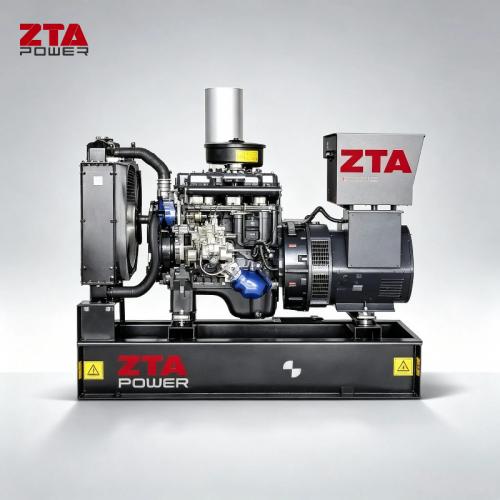
The generating end of the ZLTV5 is a complete enclosed diesel generator set, not a bare engine driving lamps. It is built as a self-contained power module so the tower can also run site tools, a small office container, or a dewatering pump when the lights are switched off.
Electrical performance
The set delivers 8 kW / 10 kVA at 0.8 power factor, single phase, 230 V output, available in 50 Hz or 60 Hz builds. Voltage is switchable between 110 V and 220 V on request, which matters for rental fleets that move equipment between regions. Protection is IP65 across the enclosure, so the electrical compartment is sealed against driven rain and dust ingress.
Silent canopy and thermal design
The enclosure is a steel canopy with acoustic lining, baffled air intake and a lockable access door sized for service without removing panels. Cooling air is drawn through louvred, dust-separating intakes and discharged away from the operator side. On a light tower this matters more than on a static genset: the unit runs for hours at a time at part load, so airflow path and radiator sizing determine whether the set derates at 45 °C ambient.
Fuel system
Fuel is carried in a 120 L polyethylene tank mounted inside the trailer frame. Polyethylene will not corrode from diesel or from condensation, and it will not rust through after years of outdoor storage — the single most common cause of tank replacement on steel-tank towers. A mechanical gauge and a lockable filler cap are standard.
The Engine: Kubota D1105, and Why This Particular Unit
The D1105 is one of the most widely serviced small industrial diesels in the world, which is the point. A light tower often works in places where the nearest authorised dealer is a day's drive away; an engine that every diesel mechanic recognises, and that parts can be sourced for locally, is worth more than a marginally better power curve.
|
Engine parameter
|
Kubota D1105
|
|
Configuration
|
Three-cylinder, four-stroke, indirect injection
|
|
Displacement
|
1.21 L
|
|
Bore × stroke
|
78 × 78 mm
|
|
Cooling
|
Water-cooled, belt-driven radiator fan
|
|
Rated speed
|
1500 rpm (50 Hz) / 1800 rpm (60 Hz)
|
|
Aspiration
|
Naturally aspirated
|
|
Fuel
|
Diesel, EN 590 / ASTM D975 equivalent
|
What the three-cylinder layout buys you
Three cylinders at 1500 rpm produce a smoother torque delivery at the light loads this tower actually runs at than a two-cylinder equivalent, and less vibration transmitted into the mast — vibration at the mast base is amplified roughly sevenfold at the lamp head, and it is what cracks lamp brackets over time. The engine sits on anti-vibration mounts, coupled to the alternator through a flexible disc coupling rather than a rigid flange.
Service reality
Oil and filter service intervals follow Kubota's standard schedule. Belts, filters, injectors and water pumps are common across the D1105's many applications, so a rental fleet can stock one parts kit for its whole light tower fleet. Fuel consumption at typical lighting load works out to roughly 1.3 L/h, which is what produces the ~90 hour runtime figure from a 120 L tank.
The Alternator: Brushless Single-Phase, Built for Long Duty Cycles
The alternator is a brushless, self-excited single-phase machine rated 8 kW / 10 kVA at 230 V. Brushless excitation removes the carbon brushes and slip rings that otherwise become a scheduled maintenance item on a machine running eight hours a night, five nights a week.
Why single phase is the right choice here
A light tower's load is single-phase by nature: LED drivers, a small site office, hand tools, a battery charger. A three-phase alternator would add cost and complexity with no benefit. The single-phase winding is wound to carry the full 8 kW on one output, with voltage held within ±1.5% from no load to full load — LED drivers are sensitive to voltage sag, and a soft output shows up immediately as flicker.
Harmonic behaviour with LED loads
LED floodlights present a non-linear load with meaningful third-harmonic content. The alternator winding is sized with additional thermal margin so that harmonic heating does not push the winding past its insulation class limit during continuous night operation. This is one of the differences between an alternator specified for lighting duty and a general-purpose unit of the same kVA rating.
Mast and Lighting System
The mast extends to 7.5 m in five telescopic sections and rotates a full 360°, so a single unit can be aimed at a work face, a haul road, or a perimeter without repositioning the trailer. Lift is manual via winch and cable — deliberate, because it removes the hydraulic system that is the most frequent failure point on competing towers.
|
Lighting system
|
Specification
|
|
Lamp type
|
LED floodlight, 4 units
|
|
Lamp power
|
4 × 400 W
|
|
Luminous flux
|
4 × 52,000 lm = 208,000 lm total
|
|
Mast height
|
7.5 m maximum, 5 telescopic sections
|
|
Rotation
|
360° manual rotation with locking
|
|
Lifting
|
Manual winch and cable
|
|
Coverage
|
Typically 3,000–5,000 m² at working illuminance (site-dependent)
|
Coverage note: actual lit area depends on required illuminance, lamp tilt and mounting height. Tell us the lux level your site standard requires and we will calculate the number of towers needed rather than quoting a generic area figure.
Trailer, Stability and Transport
The trailer is a single-axle leaf-spring chassis with a retractable, adjustable tow bar and four manual jack stabilisers. The jack legs are what make the tower safe: with the mast at 7.5 m, the overturning moment is substantial, and the stabilisers transfer that load to the ground instead of into the tyres.
|
Trailer specification
|
Detail
|
|
Axle and suspension
|
Single axle, leaf spring, without brake
|
|
Tyres
|
14" rim / 185 tyre
|
|
Stabilisers
|
4 pcs manual jack legs
|
|
Tow bar
|
Retractable and adjustable
|
|
Max tow speed
|
80 km/h
|
|
Wind resistance
|
≥ 110 km/h, mast fully extended
|
|
Control panel
|
SmartGen 5, electric start, digital hour meter, 12 V battery
|
How the ZLTV5 Is Assembled: Eight Production Stages
Every unit passes the same eight-stage build sequence, and each stage has a hold point where the unit cannot move forward until the previous check is signed off. This is what allows us to quote a fixed 30-day lead time instead of a range.
1. Steel preparation. — Canopy panels and chassis members are cut on a fibre laser and formed on CNC press brakes. Cut edges are deburred before welding to avoid stress risers in the canopy frame.
2. Chassis and frame welding. — The trailer chassis, axle mounting points and mast base plate are welded as one assembly on a jig, which fixes the mast verticality before painting. Weld seams are inspected and dressed.
3. Surface treatment. — Shot blasting, then electrostatic powder coating, then oven curing. Coating adhesion is checked on a sample panel from each batch — this is the step that decides whether the unit still looks new after three years outdoors.
4. Canopy build-up. — Acoustic lining, doors, locks, hinges, louvred intake and exhaust sections are fitted. Door alignment and seal compression are checked with a feeler gauge so the IP65 rating is not lost at the door line.
5. Engine–alternator coupling. — The D1105 and alternator are mounted on anti-vibration pads and coupled through a flexible disc. Coupling alignment is measured and recorded; misalignment here is the root cause of most bearing noise complaints in the field.
6. Systems assembly. — Radiator and coolant circuit, exhaust with silencer, fuel lines from the 120 L tank, battery, and the SmartGen 5 control panel with full wiring harness. All terminations are torqued to spec and marked.
7. Mast and lamp assembly. — Five mast sections are assembled and the cable management system is run and tested through the full stroke. Lamp bars, four LED floodlights and the tilt mechanism are fitted and aimed.
8. Testing and release. — Load bank test at rated and overload, insulation resistance test, earth continuity test, full mast extension and rotation test, lamp function test, and a final visual inspection. Test data is filed against the unit serial number.
Factory Equipment and Production Flow
Production runs through a single-direction flow: cutting and forming at one end, testing and packing at the other. Nothing moves backwards, which is why a unit can be built, tested and packed inside 30 days without queueing between departments.
|
Equipment
|
Function in the light tower build
|
|
Fibre laser cutter
|
Canopy panels, brackets, mast plates — burr-free edges for coating
|
|
CNC press brake
|
Panel forming and flange bending to consistent angles
|
|
Welding stations
|
Chassis, mast base, axle mounts — jig-fixed for repeatability
|
|
Shot blast booth
|
Surface preparation before powder coating
|
|
Powder coating line
|
Electrostatic spray plus oven cure for exterior durability
|
|
Assembly bays
|
Engine, alternator, canopy and mast integration
|
|
Load bank test bench
|
Rated load, overload and voltage regulation verification
|
|
Insulation and earth test set
|
Electrical safety verification before release
|
|
Mast test rig
|
Full-stroke extension, cable tension and rotation check
|
Production workflow, end to end
1. Order and technical confirmation. Voltage, frequency, lamp configuration and trailer options locked against a signed drawing.
2. BOM release. Engine, alternator, controller and steel released to the floor with the unit serial number.
3. Fabrication. Cutting, forming, welding of chassis and canopy.
4. Coating. Blasting, powder coating, curing, inspection.
5. Assembly. Mechanical, fuel, exhaust, electrical, mast and lighting build-up.
6. Testing. Load, insulation, earth, mast and lamp tests with recorded results.
7. Pre-delivery inspection. Photo set taken of each unit and sent to the buyer before packing.
8. Packing and container loading. Mast retracted, lamps protected, unit secured, loading plan issued.
Packing Details, Dimensions and Container Loading
Transport configuration is what determines freight cost per unit, so it is worth being specific. With the mast fully retracted and the lamp bar folded, each unit is packed as a complete towable trailer — it does not need to be partially disassembled for shipping.
|
Packing and loading
|
Detail
|
|
Working envelope
|
2600 × 2700 × 9000 mm (mast extended, lamps deployed)
|
|
Net weight
|
840 kg per unit
|
|
Mast during transport
|
Fully retracted, locked, cable secured
|
|
Lamp protection
|
Lamp bar folded; LED heads wrapped in bubble film and EPE foam
|
|
Body protection
|
Full wrap film over canopy and chassis; desiccant bags inside the electrical compartment for sea freight
|
|
Securing in container
|
Wheel chocks plus timber bracing to container floor rings; no metal-to-metal contact
|
|
Accessory pack
|
Operation manual, tool kit, spare fuses and relays, one set of lamps seals
|
|
20'GP
|
6 units
|
|
40'HQ
|
20 units
|
Loading plan: for fleet orders we issue a container loading drawing before production starts, so the buyer's forwarder can confirm the plan and the trucking arrangement in advance. Units are loaded in delivery order to match site phasing.
[ 插入图片:light-tower-zltv5-factory.jpg — alt: ZTA Power ZLTV5 mobile light tower with 7.5m telescopic mast and four 400W LED floodlights, photographed in the Xiamen factory yard ]
ZLTV5 in the Xiamen factory yard — mast fully extended, four LED floodlights deployed, orange mast cradle folded for transport.
Company Strength: Who Builds This Unit
Xiamen ZTA Power System Co., Ltd is a diesel generator set manufacturer based in Xiamen, Fujian, supplying canopy gensets, containerised power plants, mobile lighting towers and control systems to distributors, rental fleets and EPC contractors. The same factory that builds our silent diesel generator range builds the ZLTV5 — engine assembly, canopy fabrication, coating, wiring and load testing all happen under one roof, which is why we can hold a 30-day lead time and control the quality of every interface.
[ 插入图片:zta-power-factory-xiamen.jpg — alt: ZTA Power diesel generator factory in Xiamen, China — assembly workshop ]
Assembly workshop, Xiamen — diesel gensets, canopy fabrication and light tower build-up share the same floor.
[ 插入图片:zta-power-load-test-bay.jpg — alt: Generator load bank testing at ZTA Power before shipment ]
Load bank testing — every unit is run at rated load and overload before it is released for packing.
|
Capability
|
What it means for your order
|
|
In-house fabrication
|
Canopy, chassis and mast base built on site — no third-party tolerance stack-up
|
|
In-house coating
|
Blast and powder coat controlled in-house, not outsourced to a job shop
|
|
Load testing before shipment
|
Test data filed per serial number and available on request
|
|
Series production
|
Fleet orders built as a batch with identical configuration and interchangeable parts
|
|
Export experience
|
Container loading plans, export packing and documentation for Africa, Middle East, Southeast Asia and Latin America
|
Where the ZLTV5 Fits — and What It Pairs With
The ZLTV5 covers lighting and small single-phase loads. When a site needs continuous three-phase power alongside lighting, it is normally paired with a canopy diesel generator from our main range — see the hybrid energy generator set range for sites where diesel runtime needs to be cut with solar and battery storage, or browse silent diesel generators for prime and standby power from 20 kVA upwards.
|
Typical application
|
Why this configuration works
|
|
Construction sites
|
Night shift lighting plus 230 V single-phase tools from one unit
|
|
Mining and quarry benches
|
Sealed IP65 enclosure and dust-separating intakes; no hydraulics to fail
|
|
Oil, gas and pipeline camps
|
90 h runtime means one refuel per week; Kubota parts locally available
|
|
Rental fleets
|
Towable at 80 km/h, single-axle, no brake maintenance; 20 units per 40'HQ
|
|
Emergency and disaster response
|
Deploys behind any pickup; lights and 8 kW of power from one trailer
|
|
Events and temporary compounds
|
Silent canopy keeps noise inside event and residential limits
|
Frequently Asked Questions
What is the ZLTV5 light tower used for?
It provides mobile night-time lighting and 8 kW of single-phase power from one towable trailer. Typical uses are construction sites, mining benches, pipeline and oil camp lighting, rental fleets, event compounds and emergency response where no grid connection exists.
How long does it run on one tank of fuel?
Approximately 90 hours from the 120 L polyethylene tank with all four LED floodlights running. At roughly 1.3 L/h consumption this covers a full working week of night shifts on a single fill, which is the main reason sites choose it over units requiring daily refuelling.
Which engine is fitted, and are parts available locally?
The Kubota D1105 — a three-cylinder, 1.21 L, water-cooled industrial diesel running at 1500 rpm for 50 Hz. It is one of the most widely serviced small diesels in the world, so filters, belts, injectors and water pumps are normally available through local Kubota distributors rather than requiring factory shipment.
Can you supply 60 Hz or 110 V versions?
Yes. The unit is built in 50 Hz or 60 Hz versions, with output selectable at 110 V or 220 V on request. Voltage and frequency must be fixed at the time of order because they determine the alternator winding and engine speed.
How much area does it light?
With 208,000 lm total output at 7.5 m, it typically covers 3,000–5,000 m² at working illuminance, depending on the lux level your site standard requires and how the four lamp heads are aimed. Send us the required lux figure and we will calculate the number of towers, rather than quote a generic area.
Is it road legal to tow, and how stable is it in wind?
It tows at up to 80 km/h on a single-axle leaf-spring chassis with 14" rims and 185 tyres. With the mast fully extended the trailer is rated for wind speeds of 110 km/h or more, provided the four manual jack stabilisers are deployed — they are mandatory whenever the mast is raised.
What is the minimum order quantity and lead time?
One unit for a sample or trial order, and 30 days from receipt of deposit for standard configuration. Fleet orders are built as a batch; the container loading plan is issued before production starts so your forwarder can confirm arrangements in advance.
How many units fit in a container?
Six units in a 20'GP and twenty units in a 40'HQ. Units ship as complete towable trailers with the mast retracted and the lamp bar folded — no partial disassembly is required, which keeps reassembly time at the destination close to zero.
What warranty and documentation are included?
Twelve months or 1,000 running hours, whichever comes first. Each unit ships with an operation manual, tool kit, spare fuses and relays, and a test record filed against its serial number. Certification documents and test reports are provided on request with the quotation.
Can the trailer be customised?
Yes — lamp configuration, mast height options, paint colour and branding, tow bar type and stabiliser arrangement can all be adapted. Customisation affects lead time, so confirm the specification before the deposit is placed.
Request a Quotation (RFQ)
Send the details below and you will receive a quotation with EXW and FOB pricing, container loading plan and lead time within one working day.
|
RFQ field
|
What we need from you
|
|
Quantity
|
Sample unit, or fleet quantity (state target container size if known)
|
|
Voltage / frequency
|
110 V or 220 V; 50 Hz or 60 Hz
|
|
Lighting requirement
|
Required lux level or area to be lit, if lighting design support is needed
|
|
Destination port
|
For FOB / CIF pricing and loading plan
|
|
Configuration notes
|
Trailer options, paint colour, branding, any site-specific requirements
|
|
Commercial terms
|
Preferred payment terms and required delivery window
|
Contact: Xiamen ZTA Power System Co., Ltd · Room C5, No.113, Chengyi North Street, Software Park III, Torch High-tech Zone, Xiamen, China · www.ztapower.com




 IPv6 network supported
 English
 français
 русский
 español
 português
 العربية
 Türkçe
 ไทย
 Tiếng Việt
 Indonesia
 Filipino